|
|
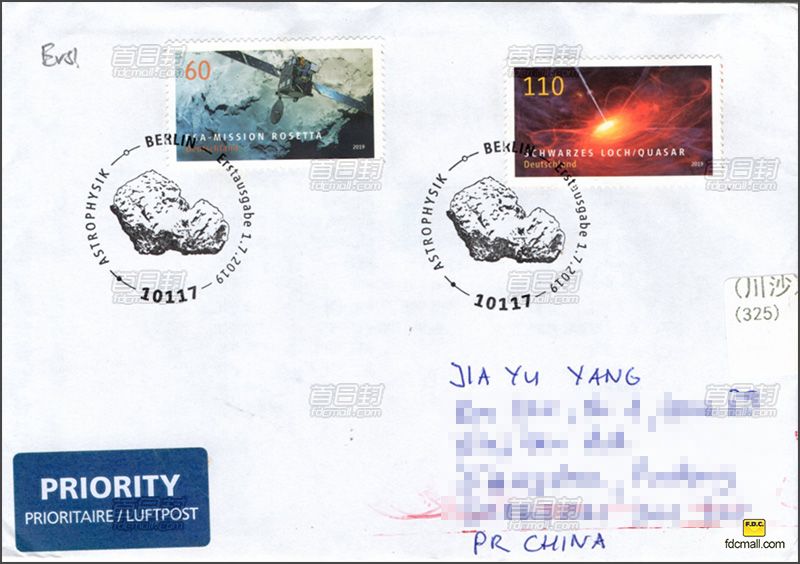
德国2019‑07‑01发行《天体物理学》邮票全套2枚,面值0.6欧元和1.1欧元,0.6欧元邮票的图案为欧洲空间局 ESA 罗塞塔号(Rosetta)彗星探测器,环绕 67P / 楚留莫夫‑格拉希门克彗星;背景是深邃星空、蓝色星云,线条现代科技感;1.1欧元邮票的图案为引力透镜与深空宇宙,主图选用了欧洲南方天文台(ESO)著名艺术家马丁·科梅塞尔(M. Kornmesser)绘制的超大质量黑洞驱动早期已知类星体(ULAS J1120+0641)的艺术想象图,画面中央是一个无比耀眼的炽热发光区域。它表现的是大量物质(如气体、尘埃和撕裂的恒星)在超大质量黑洞巨大的引力拉扯下,高速旋转并向中心塌陷所形成的“吸积盘”。物质在此处剧烈摩擦、升温,释放出极其巨大的辐射与光芒,这也是类星体成为宇宙中最明亮天体的原因。首日封贴全套2枚邮票,符合寄往中国的国际航空起重邮资,盖首日纪念戳,图案为图案是月球岩石(Mondgestein),寄达中国上海国际互换局加贴中文地址不干胶。
On July 1, 2019, Germany issued a set of two "Astrophysics" stamps, with face values of €0.60 and €1.10. The €0.60 stamp features the European Space Agency's Rosetta comet probe orbiting Comet 67P/Churyumov–Gerasimenko, set against a background of deep space and blue nebulae, with a modern, technological aesthetic. The €1.10 stamp depicts gravitational lensing and the deep universe. The main image is an artistic rendering by M. Kornmesser, a renowned artist at the European Southern Observatory, showing the supermassive black hole driving the early known quasar ULAS J1120+0641. At the center of the image is an extremely bright, glowing region. It represents the "accretion disk" formed by large amounts of matter (such as gas, dust, and torn‑apart stars) being pulled by the immense gravity of the supermassive black hole, spinning at high speed and collapsing toward the center. The matter rubs together intensely, heats up, and releases enormous radiation and light, which is why quasars are the brightest objects in the universe. The first‑day cover bears the complete set of two stamps, making up the required postage for the initial weight of an international airmail letter to China. The cover is canceled with a first‑day commemorative postmark featuring a moon rock design ("Mondgestein"). After arriving at the Shanghai International Exchange Bureau in China, a self‑adhesive label with the Chinese address was added.
德国
|
|
![首日封网 [集邮 邮票 首日封 实寄封 原地封 纪念封] China First Day Cover](data/attachment/common/template/boardimg_20250825g97sqpm5.png)

 IP卡
IP卡 狗仔卡
狗仔卡
 提升卡
提升卡 置顶卡
置顶卡 沉默卡
沉默卡 喧嚣卡
喧嚣卡 变色卡
变色卡 显身卡
显身卡